


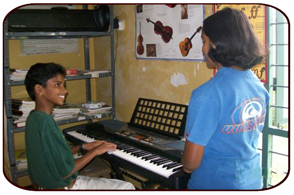
Since 2007, ASTEP has partnered with Shanti Bhavan Children's Project, a home and school for the most vulnerable and disadvantaged children of India's "lowest caste." Shanti Bhavan provides a holistic, high quality focused education to children on a beautiful boarding school campus. For these communities, Shanti Bhavan is an oasis within the confines of poverty and is supported by a devoted administration and global network of volunteers.
ASTEPs volunteer artists provide invaluable support in academics and arts education, using the arts to teach life skills, health education, college readiness and HIV/AIDS education and awareness.
"When I initially heard about Shanti Bhavan, I was looking for a way to volunteer which would enable me to feel I had directly contributed to making someone's life better. Teaching is a great way to accomplish this. I absolutely grew in that I was able to feel fulfilled in this mission. However, I also grew by specifically teaching biology. After fighting an urge to apply to medical school for a few years now, teaching biology to high school students at Shanti Bhavan [SB] gave me a new perspective on pure scientific knowledge. I now have a renewed drive to go to medical school that I believe might not have been there if I hadn't been at Shanti Bhavan [SB]." - Leah Dlugolecki, ASTEP Volunteer Artist Educator
ASTEP is currently accepting applications year round for Shanti Bhavan. Applicants must have academic teaching experience as well as an arts background to apply for this program. Opportunities begin in June with a minimum of a 4 week placement.



2007 was ASTEPs first official summer working at Shanti Bhavan. ASTEP sent 10 volunteer educators over the course of 3 months and elevated the ASTEP experience to new heights. Through our volunteers, the children were exposed to a diverse array of traditions and art, helping to build on the development of a cross cultural exchange. There was a major focus on using the arts to teach HIV/AIDS prevention and awareness -- something that is in dire need throughout the country.
In August 2007 The Shanti Bhavan 10th Anniversary School Day Performance featured ASTEP artists and ASTEP Broadway Stars accompanied by equally talented foreign artists who also performed solo musical pieces. In the fall, the 9th and 10th grade class worked with ASTEP Program Director and Juilliard graduate Mauicio Salgado to create their own full length adaptation of Shakespeares Julius Caesar.In 2008 ASTEP sent 10 volunteer educators, several of whom spent 2 months or more delivering ASTEPs curriculum and bringing a vital living arts component to the school. These artists exposed the children to many new art forms such as puppetry, opera, hip-hop and tango as well as administrated academic subjects in the areas of English Literature & Grammar, Math, Science, History and Social Studies.